At 3:08 PM on July 21, Commissioner Kyle Workman emailed Crusoe a copy of Leon County’s new tax abatement checklist. The file was named “DRAFT_2026 Tax Abatement Checklist_NOT APPROVED.pdf.” It had not been adopted. It had not been posted. The public hearing on it was six days away.
At 4:22 PM, I emailed the County Judge’s office and asked for a copy of the same document, so people could read it before the hearing. At 4:32 PM I was told it wasn’t finished and that I’d get it when it was. I never did. It went online July 29, two days after the vote.
Seventy-four minutes. That’s the gap between the applicant getting the county’s rules and a resident being told they didn’t exist yet.
That is one email out of sixty-one pages. Read together, they show something plainer than a paperwork problem: a commissioner who voted against Crusoe’s application in open court and then spent the next month acting as Crusoe’s advisor inside county government.
Which raises the question I can’t answer from these pages, and the one I keep coming back to. What would prompt an elected official to do this? To take the side of a company from Denver over the people who put him in office, the people who have filled that courtroom for months, the people whose fences sit on the road he was designing? The emails show what he did. They don’t say why. I’d like to hear him explain it.
How we know
On August 27, a records request under Chapter 552 of the Texas Government Code went to Judge Ryder and Commissioner Kyle Workman for every communication with Crusoe since July 13. Commissioner Kyle Workman answered it on September 4. Sixty-one pages, and in his words, “No exception to disclosure under Chapter 552 is being asserted with respect to any responsive record in my custody.”
I’m hosting the whole thing: the complete production. Page numbers below refer to that file. I’m also hosting my July 21 email exchange with the Judge’s office, and the county’s August 10 agenda, August 10 minutes, August 24 agenda, and September 3 agenda.
Two things to know about what this file is and isn’t. It is Commissioner Kyle Workman’s production only. Judge Ryder answered the same request separately and on time, and his response is not part of this post. I’ll say more about that at the bottom, because an earlier version of this post got it wrong. And it is emails only. The request also asked for texts, call logs, and calendar entries. None were produced, and no statement was made that none exist. I’ll come back to that.
The timeline
Every line below is a page in the production or a public document.
| Date | What happened | Where |
|---|---|---|
| July 13 | Kyle Workman moves to reject Crusoe’s abatement application “as submitted.” Presents his own draft guidelines and moves to approve them contingent on the county attorney’s review. Submits a letter asking the state for more county control over data centers. | pp. 37–38, 55 |
| July 16, 12:52 PM | Jack Winn, Crusoe’s Real Estate Strategy Manager, emails the Judge, all four commissioners, and the county attorney. Calls Monday “the beginning of an ongoing relationship.” Asks for the guidelines “approved on Monday.” | pp. 5–6 |
| July 16, 4:00 PM | Winn emails Kyle Workman alone. “I wanted to follow up with you directly.” Asks for the guidelines again, asks for a call, offers to come to Leon County to meet in person. | p. 7 |
| July 21, 3:08 PM | Kyle Workman sends Winn the draft checklist, “NOT APPROVED,” still “under review by the County Attorney.” | p. 8 |
| July 21, 4:22 PM | I ask the Judge’s office for the new guidelines and criteria. | Pittman thread |
| July 21, 4:32 PM | “I believe Keith Cook is still working on that paperwork. I will let you know as soon as it is complete.” | same |
| July 27 | Public hearing. Guidelines and checklist adopted. | county site |
| July 29 | Documents posted online. | same |
| July 30, 11:22 AM | Winn sends Kyle Workman a “preliminary draft exhibit” for a road use permit on County Road 387: hot top and seal about 5,700 feet, with “construction crossing areas for our project traffic.” Asks for feedback on “our permit application.” | p. 9 |
| July 31, 8:04 AM | Kyle Workman: “Received. I will review today and respond accordingly.” | p. 10 |
| July 31, 1:19 PM | Kyle Workman sends a nine-point engineering review of Crusoe’s road plan, with a full pavement cross-section. | pp. 12–13 |
| July 31, 2:35 PM | “If you need clarification, feel free to email or call.” | p. 14 |
| August 1, Saturday | “Additional Thoughts.” Six more items, including moving fences to widen the right-of-way to 60 feet. | p. 17 |
| August 10 | Regular court meeting. Road use agreements for CR 347/348, CR 156, and Windstream permits on the agenda. CR 387 is not. | agenda |
| August 11 | Kyle Workman emails Winn the Jewett Fall Frolic sponsorship flyer. No message, just the attachment. | p. 18 |
| August 24 | Regular court meeting. Road use agreements for CR 112, CR 224 and four others, and a solar farm on OSR on the agenda. CR 387 is not. | agenda |
| August 27, 11:36 AM | The records request is sent. | pp. 19–22 |
| August 27, 2:44 PM | Kyle Workman acknowledges it, copying the county attorney. | p. 19 |
| August 27, 5:55 PM | Winn, on the Fall Frolic thread: “Thank you again for bringing this to our attention. We are planning to support and will reach out directly to the Jewett Area Chamber of Commerce.” | p. 23 |
| September 3 | Special called meeting. Nothing about CR 387 or Crusoe. | agenda |
| September 4 | Kyle Workman’s production, no exceptions claimed. | p. 1 |
| September 5 | The Chamber’s executive director posts that she turned Crusoe’s sponsorship down. | below |
The rules went to the applicant first
Crusoe asked for the new guidelines twice on July 16, once to the whole court and once to Kyle Workman privately. Five days later Kyle Workman sent them the checklist, a document he himself labeled a draft that was “subject to substantive modifications as the final review/approval is completed” (p. 8).
I compared that draft (pp. 25–30) against the checklist the court adopted on July 27. They are the same document. The adopted version adds one paragraph requiring a written explanation for anything marked “Not Applicable,” and one line item for a letter from the appraisal office. Everything else is identical, section for section, line for line. Crusoe had the county’s rules eight days before the public did.
Seventy-four minutes after Kyle Workman sent it, I asked the Judge’s office for the same thing. Here is the exchange, hosted in full:
Me, 4:22 PM: Is it possible to get a copy of the new proposed tax abatement guidelines & criteria? It will help if people can see them before hand so they can come with intelligent comments based on what’s being proposed.
Judge’s office, 4:32 PM: I believe Keith Cook is still working on that paperwork. I will let you know as soon as it is complete.
I want to be precise about one thing. I asked for the “guidelines & criteria.” What Kyle Workman sent Crusoe was the “checklist.” They’re companion documents, adopted together on July 27, and Crusoe’s own emails had asked for “the updated application guidelines & criteria.” Kyle Workman treated the checklist as the answer to that request. The county gave the applicant the part of the package it had and told a resident who asked for the package that nothing was ready.
The Texas Public Information Act has a rule for exactly this. Section 552.007 says a governmental body may voluntarily release information it could otherwise hold back, and then adds: “Public information made available under Subsection (a) must be made available to any person.” Once the draft went to Crusoe at 3:08, the county could not lawfully tell anyone else it wasn’t available at 4:32. I don’t think the Judge’s office knew that when it answered me. That’s the point, and I’ll get to it.
Kyle Workman rejected it in public, engineered it in private
On July 13, in front of a full room, Commissioner Kyle Workman made the motion to reject Crusoe’s application. The motion was to reject it “as submitted” (p. 37). Crusoe read that the way it was written. Three days later Winn wrote to the whole court: “We viewed Monday as the beginning of an ongoing relationship and dialogue with Leon County” (p. 5).
Seventeen days after the vote, Crusoe sent Kyle Workman its plan for County Road 387. That’s the gravel road the entire project sits on, the one that runs from Highway 79 past the railroad tracks and dead-ends with Crusoe’s 805 acres on both sides. Crusoe wanted to pave about 5,700 feet of it and mark where its construction traffic would cross.
Kyle Workman answered the next day. Not with “bring it to court.” With a spec. Here it is, from page 12, in his words:
Thank you for submitting this exhibit outlining the extents of your proposed road improvements to CR 387. As you know, this road is a narrow gravel country road which will need to be upgraded to serve your probable needs.
I have reviewed and offer the following:
- I believe the 5700 ft is generally correct.
- The actual road use permit application can be found at [county link]
- I need you to address the following: a. Portion of CR387 from the highway to the railroad tracks b. The RR Crossing - have you coordinated with Union Pacific? I suspect this will need to be upgraded as well.
- The “Construction Crossing” section needs to receive additional subgrade and surface improvements to ensure durability. I suggest 8" reinforced concrete (detailed specifications can be provided).
- It is highly likely that the road will need to be raised, at least in part, to provide adequate drainage; culverts may be needed at driveways and/or crossings.
- There will need to be reinforced concrete (min 6") approaches at all adjoining driveways.
- You will provide the necessary testing to ensure compliance.
- All concrete to be properly reinforced.
- Below is an example of the minimum road section I would expect for the road (including the section between the HWY/RR), exclusive of the concrete discussed above.
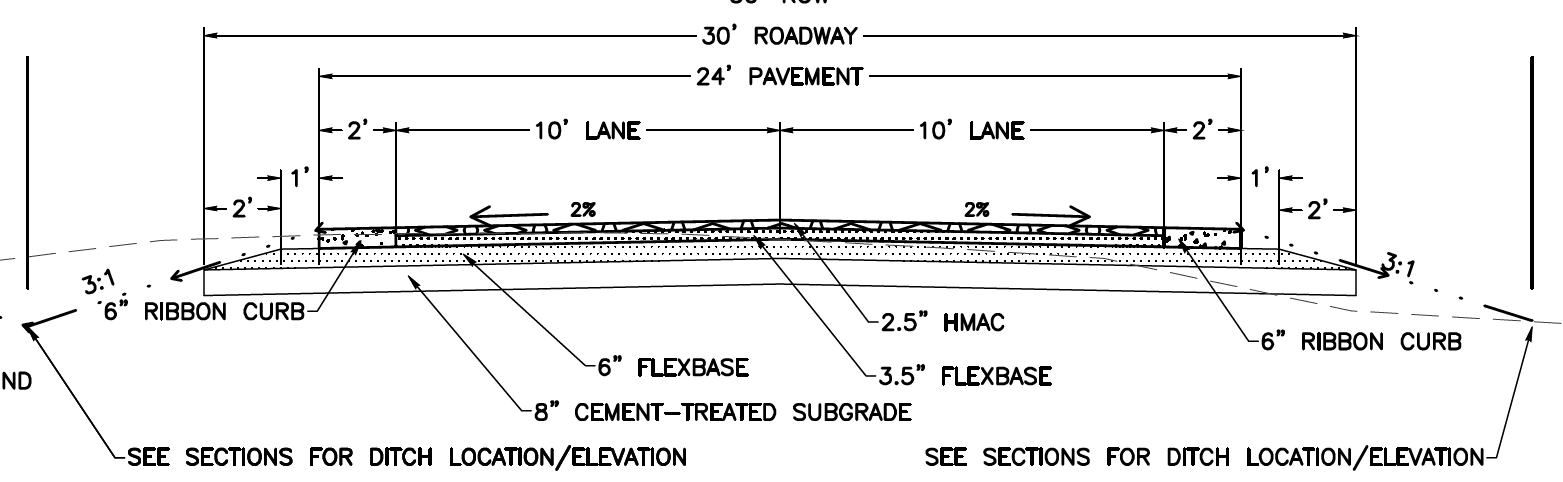
The road section Commissioner Kyle Workman sent Crusoe on July 31. Source: page 12 of the production.
I will expect the final agreement(s) to be referenced and memorialized in an attachment to the road use agreement/permit. It likely goes without saying, but I will need you to include, within the agreement, that you will maintain the road during your construction activities and repair it as necessary at the completion of the work.
I am happy to meet out there to discuss.
An hour later: “if you need clarification, feel free to email or call” (p. 14). The next day, a Saturday, six more items (p. 17): traffic control because CR 387 is a dead-end road that has to stay open, culverts at the crossing, dust control, revegetation, and advice on how Crusoe should sequence its paving around its own construction schedule. He signs off: “I reserve the right to continue my evaluation.”
Let me be fair about what this is. Reviewing a road permit in his precinct is part of a commissioner’s job, and the county’s own permit form routes damage claims and bond amounts through the precinct commissioner. The technical demands are protective: concrete crossings, testing, maintain-and-repair obligations, keeping the road open. If a county engineer had written this memo to the court, I’d be quoting it approvingly.
But it wasn’t written to the court. It was written to Crusoe, by the man who’d just voted to reject them, in the voice of the person who decides. “I will expect.” “I need you to address.” “I reserve the right to continue my evaluation.” And the court has never seen it.
That last part is checkable. Leon County’s Special Road Use Indemnity Agreement and Permit, the form Kyle Workman linked Crusoe to, is an agreement “with the Commissioners Court of Leon County,” and its bonds and insurance “shall be approved by Commissioners Court before any permit is issued.” State law says the same. Transportation Code § 252.106: “A road commissioner’s acts are subject to the control, supervision, orders, and approval of the commissioners court.” That’s how it works in practice here, too. On July 13, the court voted on road use agreements for CR 156 and CR 220–222. On August 10, CR 347/348, CR 156 again, and a Windstream permit. On August 24, CR 112, CR 224 and four others, and a solar farm on OSR. Eight road use agreements and permits went on public agendas in six weeks.
CR 387 was not among them. Not August 10. Not August 24. Not September 3. Crusoe called it “our permit application” on July 30, and as of this writing, the only place it appears in any public record is a commissioner’s inbox.
The fence line
Item 6 of the Saturday email is the one the people on 387 need to read:
I would like to discuss replacing the fencing to achieve a 60’ ROW. During these types of projects, I try to widen the ROW to the prescribed width to allow for future utilities and ongoing maintenance (such as mowing and drainage work). Admittedly, some adjacent landowners may not want their fences moved and we will work with them to ensure they are agreeable to the final plan.
Read it again. A county commissioner is proposing to move the fences of people who live on a county road to make room for a data center’s traffic and utilities, and he raised it with the data center first. The “adjacent landowners” learned about it through a records request.
Be precise about who that is. Crusoe’s parcels sit on both sides of 387 for most of its length, so for most of the road, the neighbor is Crusoe. The fences that matter belong to the people who aren’t selling: the homes and rural tracts between the highway and the dead end. Those are the people Kyle Workman concedes “may not want their fences moved.” He’s right. They don’t.
And here is the part that should end the conversation. Crusoe is buying 805 acres along this road. If CR 387 needs to be 60 feet wide, the company can widen it onto its own land. There is no reason on earth for the widening to come out of the neighbors who stayed, to serve the buyer who doesn’t need it.
Commissioner Kyle Workman’s campaign site lists, under what he stands for: “Defend private and County property rights and oppose HSR entirely.” He built his public reputation fighting a private company’s use of eminent domain on Leon County land. The people on 387 might ask him what changed.
Showing Crusoe how to win friends
On August 11, ten days after the fence email, Commissioner Kyle Workman sent Jack Winn one more thing (p. 18). No message. Just his signature block and an attachment: the sponsorship flyer for the 45th Annual Jewett Fall Frolic (pp. 31–32). Tiers from $100 to $6,000. Sponsorship deadline August 28.
Crusoe understood. On August 27, three hours after Kyle Workman acknowledged the records request that would produce these emails, Winn replied: “Thank you again for bringing this to our attention. We are planning to support and will reach out directly to the Jewett Area Chamber of Commerce” (p. 23). Kyle Workman: “Thank you” (p. 24).
Here’s what happened next, in the words of Kristy Vandegriff, the Chamber’s executive director, in a public Facebook post on September 5:
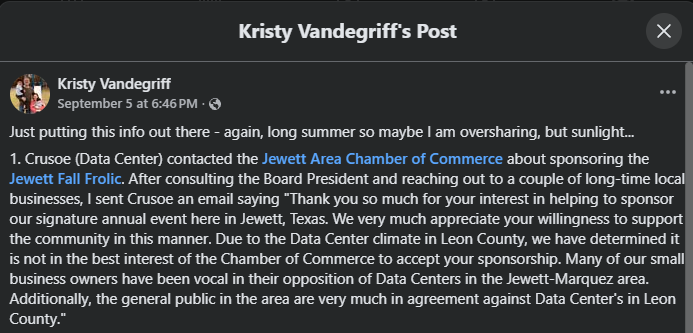
Kristy Vandegriff, September 5, 2026. Full post here.
Crusoe (Data Center) contacted the Jewett Area Chamber of Commerce about sponsoring the Jewett Fall Frolic. After consulting the Board President and reaching out to a couple of long-time local businesses, I sent Crusoe an email saying “Thank you so much for your interest in helping to sponsor our signature annual event here in Jewett, Texas. We very much appreciate your willingness to support the community in this manner. Due to the Data Center climate in Leon County, we have determined it is not in the best interest of the Chamber of Commerce to accept your sponsorship. Many of our small business owners have been vocal in their opposition of Data Centers in the Jewett-Marquez area. Additionally, the general public in the area are very much in agreement against Data Center’s in Leon County.”
Her post doesn’t say where the referral came from. The emails do. Now she knows for certain how it came in.
Look at the two processes side by side. Before answering Crusoe, the Chamber director consulted her board president and called long-time local businesses. Before pointing Crusoe at the Chamber, the county commissioner consulted nobody that appears in any record, and sent the flyer without a word. The Chamber asked the community and said no. The commissioner didn’t ask and said yes.
This isn’t about a sponsorship. It’s about what Kyle Workman was doing on August 11. The town doesn’t want Crusoe. Kyle Workman knows that. And he was coaching Crusoe on how to buy a little goodwill in Jewett anyway, as the commissioner for the precinct where the project would sit.
What it adds up to
Three different kinds of help, to the same applicant, in twenty-one days, from the commissioner who moved to reject it:
- July 21. The county’s rules, before the public hearing and before the public.
- July 31 to August 1. The road, engineered and negotiated privately, never brought to court.
- August 11. A path to community goodwill, handed over with no message attached.
None of it was disclosed. Not at the July 27 hearing, not at the August 10 meeting, not at the August 24 meeting. The only reason any of it is known is that someone asked for the emails.
Set that against the room. The July 13 minutes are in Kyle Workman’s own production, pages 33 through 57. Page 36 lists twenty-three people who signed up to speak about the data center at the first public comment period, and page 54 lists three more at the second. I was one of them. Hundreds of people have come to that courtroom since spring. The Chamber of Commerce, which exists to bring business to Jewett, turned down the company’s money because its own members are against it.
Commissioner Kyle Workman knows all of that. He was in the room. He moved to reject the application. And then he went back to his office and helped.
Is any of this illegal?
Straight answer: one thing was, one thing is a prosecutor’s call, and one thing I can’t tell you.
As I read Section 552.007, the disclosure violated it. I don’t think it’s a close call. Once Kyle Workman released the draft to Crusoe, the county was required to make it available to anyone who asked. I asked. I was told it didn’t exist yet. The statute doesn’t have an exception for “we hadn’t told the Judge’s office.”
Whether that’s a crime is not mine to decide. Section 552.353 of the Government Code makes it an offense for an officer for public information, or that officer’s agent, to fail or refuse to provide public information “with criminal negligence.” The Act defines the duty as producing records “promptly,” which the statute itself defines as “as soon as possible under the circumstances, that is, within a reasonable time, without delay.” The document existed. It had already been released. It wasn’t sent. The statute lists three affirmative defenses, and none apply: no court order, no Attorney General request, no lawsuit. But “criminal negligence” means someone ought to have been aware of a substantial risk, and that requires a prosecutor to look at what the Judge’s office knew at 4:32 PM. The prosecutor who would make that decision is the county attorney, who was copied on Kyle Workman’s response letter and was the person the Judge’s office said was still working on the document. I’ll let you weigh that.
Here’s the part that matters more than the statute. Section 552.353 doesn’t reach the commissioner. It reaches the officer for public information and the officer’s agent. That’s the County Judge and the assistant who answered my email. When Commissioner Kyle Workman released that document to Crusoe, he created a legal exposure for the Judge’s office that the Judge’s office didn’t know it had. Tammy Pittman told me the paperwork wasn’t done, which was true as far as she knew, and 74 minutes earlier a commissioner had turned that honest answer into a Section 552.007 problem for her boss. He didn’t break that statute. He handed the risk of breaking it to two other people. If he told them in writing, that email would mention Crusoe, and it would be in this production. It isn’t. I can’t rule out a phone call.
The road. Nothing about a commissioner reviewing a road permit is illegal. Deciding it alone and keeping it off the agenda for six weeks isn’t a crime either. It’s just not how the law says it works, and it’s not how this court handles every other road in the county.
Workman Advisors. Commissioner Kyle Workman owns a construction consulting firm. Its website says it does owner representation: due diligence, site evaluation, contractor evaluation, construction oversight. The July 31 email reads like that kind of work, applied for free on Crusoe’s behalf. I want to be clear: nothing in these sixty-one pages, and nothing I’ve found anywhere else, shows any business relationship between that firm and Crusoe, Crusoe’s contractors, or the landowner. This post doesn’t claim one. Texas law, Chapter 176 of the Local Government Code, requires an officer and a vendor to file conflict-of-interest forms with the county if such a relationship exists. I asked about those. See the list below.
What’s still missing
The request asked for more than emails. This is what wasn’t in the sixty-one pages, and what has been asked for since. For each item, the county can produce it or state in writing that it doesn’t exist.
- The CR 387 road exhibit. Winn’s July 30 email attached a 508 KB file called “CR-387 Road Exhibit.pdf.” It’s the map of what Crusoe wants to do to the road. It was not produced.
- Calls and texts. Kyle Workman told Crusoe to call. Winn asked for a call and an in-person meeting. Kyle Workman offered to “meet out there.” No call logs, no texts, and no calendar entries were produced, and no one said there are none.
- The permit. Winn called it “our permit application.” Any application, bond, or insurance certificate Crusoe has filed for CR 387.
- Every recipient of the Fall Frolic flyer. If Kyle Workman sent it to every business in Jewett, that’s one thing. If he sent it to Crusoe, that’s another.
- Chapter 176 filings. Judge Ryder told me by phone on September 8 that in his 24 years with the county, no Conflicts Disclosure Statement or Conflict of Interest Questionnaire has ever been filed by anyone, and that no conflicts exist to his knowledge. I take him at his word. It also means the county has no process that would have surfaced one.
Judge Ryder’s response. The same request went to him.Correction, September 10: Judge Ryder did respond, and he did so promptly. His reply was caught by a spam filter and wasn’t seen until after this post went up. See the correction below.
This file stays open. I’ll post what comes back.
Check this yourself
- The complete production, 61 pages, with Kyle Workman’s September 4 cover letter on page 1
- My July 21 exchange with the Judge’s office
- The adopted 2026 checklist, to compare against the draft on pages 25–30
- County agendas: August 10 and minutes, August 24, September 3, and the county’s agenda page
- Leon County’s road use permit form
- Government Code § 552.007, § 552.221, and § 552.353; Transportation Code § 252.106
- Kristy Vandegriff’s September 5 post
- My earlier posts on the Crusoe application and what the July 27 rewrite took out of the abatement rules
If I’ve read any of this wrong, I want to know, and I’ll correct it here with the same prominence. Every claim above points to a page. You don’t have to take my word for any of it.
Correction and an apology to Judge Ryder
When this post was first published, it listed Judge Ryder’s response to the records request as outstanding. That was wrong. Judge Ryder responded, and he responded promptly. His reply was caught by a spam filter on the receiving end and sat there unread. Nobody at the county did anything wrong here. The mistake was ours, and it was mine to publish.
I said above that if I read any of this wrong, I’d correct it with the same prominence. So: Judge Ryder answered the request in a timely manner, and the earlier version of this post implied he hadn’t. Judge Ryder, I apologize for that.
I’ll go through his response and post what it shows.