There’s a new application sitting in the County Judge’s office, and it’s a big one. Crusoe Technologies, LLC — a Denver company — wants Leon County to carve a piece of Precinct 3 into a reinvestment zone and grant it a property tax abatement to build an AI data center campus. Multiple buildings, electrical substations, banks of backup generators. The works.
They’ve put a number on it: $34 billion at full build-out. That number does a lot of heavy lifting in this application, so I read the whole thing — alongside the county’s own abatement rules — to see what we’d actually get in return. The short version: not much, and they’re asking for more than our rules allow.
I’ve hosted copies of both so they can’t quietly disappear: the Crusoe application and the county’s tax abatement guidelines. Read along. If the mechanics are fuzzy, I’ve written explainers on what a tax abatement is and what a reinvestment zone is, plus a piece on why the abatement is the only real leverage we have.
Where this would actually go
If you live around Marquez, you already know this stretch of road. The parcels begin right at the corner of Highway 79 and County Road 387, just outside town, and run the length of 387 — with tracts on both sides — all the way to where the road dead-ends. About 805 acres in all.
This isn’t some empty industrial corner. It’s a county road people drive every day, lined with homes and rural property. Hold that picture for the noise section below — the constant hum, the generators — and now imagine it running down both sides of 387 with your place in the middle. The families at the dead-end of that road didn’t choose to live next to a facility the size of a small power plant. The facility is being brought to them.
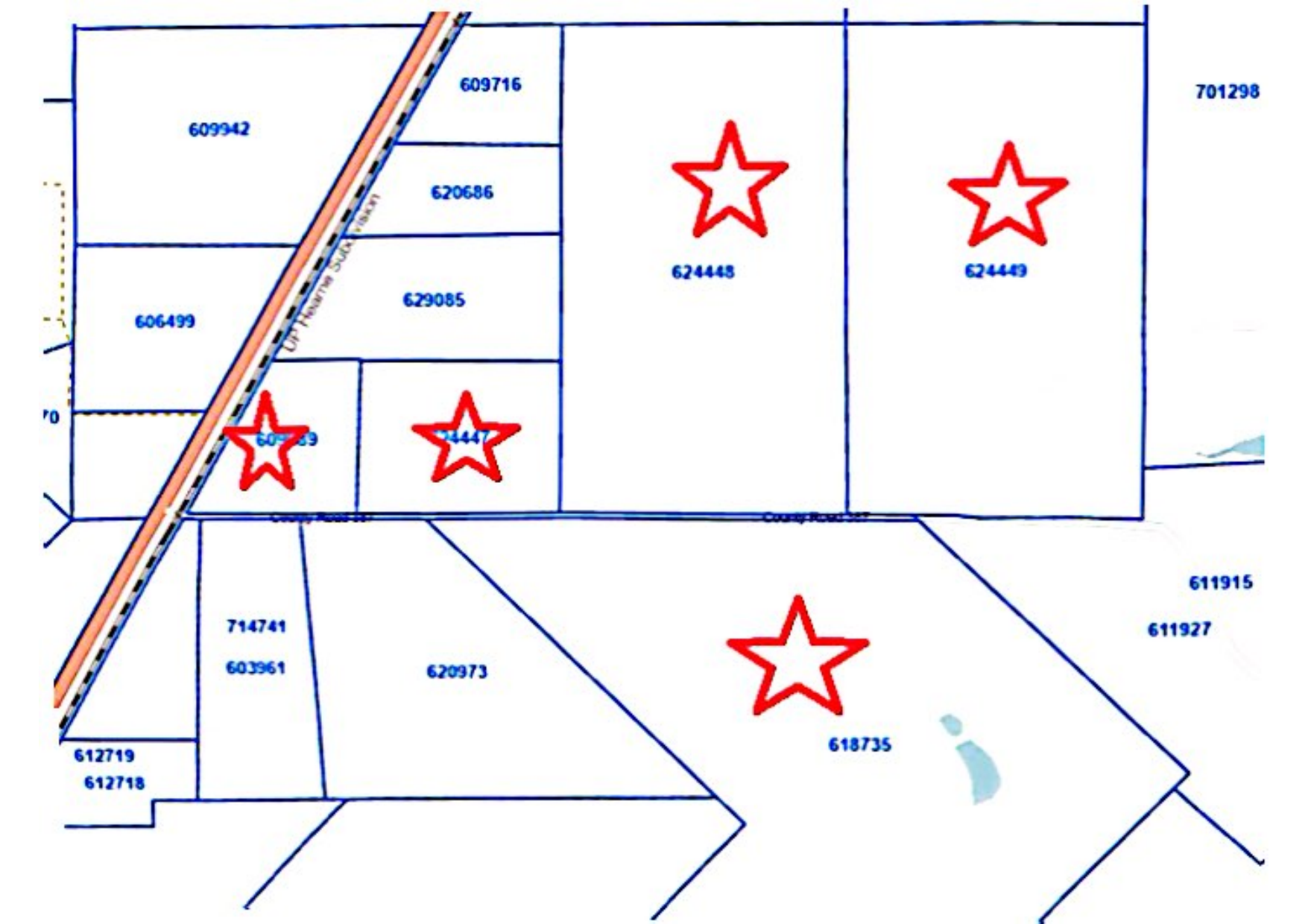
The five parcels in the proposed reinvestment zone (red stars), running down both sides of County Road 387. The diagonal line at left is the railroad along Highway 79. Source: Exhibit A of the Crusoe application.
Here’s the official breakdown straight from the application, with the county’s own acreage on each tract:
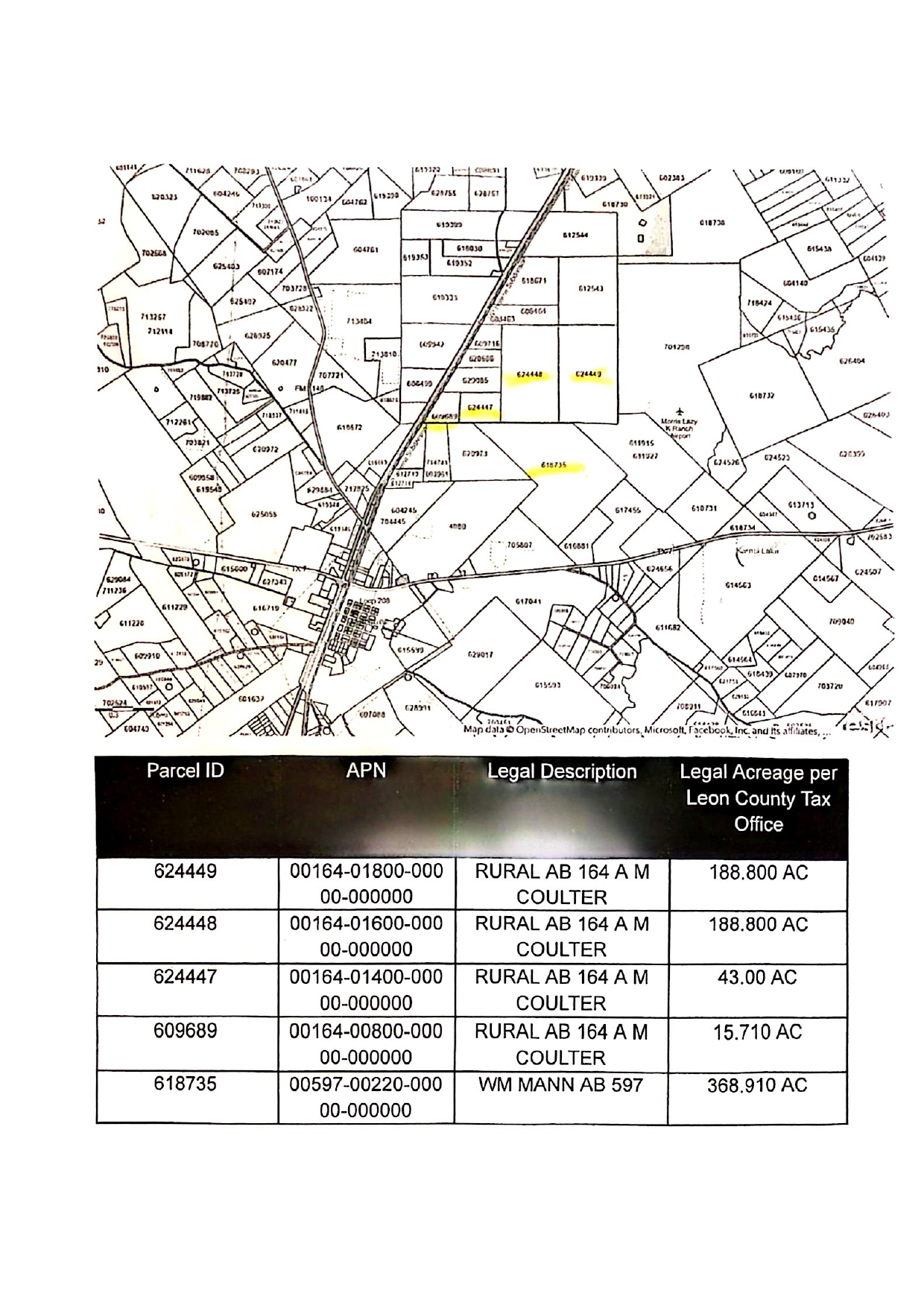
The plat and parcel table from the application: 624449 (188.8 ac), 624448 (188.8 ac), 624447 (43 ac), 609689 (15.71 ac), and 618735 (368.91 ac). Source: Exhibit A of the Crusoe application.
Who’s selling the land
The application is happy to tell you about $34 billion in future investment. It’s a lot quieter about who gets paid today — in fact, it never names the current landowner at all. That part you have to dig up yourself.
So I did. Run the five parcel IDs through the Leon County Appraisal District and the same name comes back on every one: ROCKIN B L HOLDINGS LP. That’s the seller. Crusoe is the buyer-in-waiting, contingent on the tax deal closing.
I’m not saying that to pick on anyone — a landowner is free to sell their land. But when the county is asked to give up tax revenue to grease a private sale, the public ought to know who stands on both sides of it.
What they’re asking for
Stripped down: give us a reinvestment zone, then abate the property taxes on our improvements as deeply and for as long as the law allows.
They point to the county’s Step Three tier — the most generous one we offer — and then, in the same breath, ask us to beat it. I’ll come back to that, because it’s the part that stopped me cold.
The timeline they lay out: Buildings 1 and 2 break ground in late 2026 and finish by the end of 2029; Buildings 3 and 4 follow by the end of 2030 and run by 2034. The first payment-in-lieu-of-taxes might land in the 2028 tax year — “but is subject to change,” they add. Financing is 80 to 95 percent debt, the rest from Crusoe and equity partners.
On paper, it’s a real project. The trouble starts when you read how they answer the questions the county actually asks.
“As needed,” “approximately,” “subject to change”
The county’s form isn’t hard. It asks plain questions. Crusoe’s answers, over and over, are the kind you give when you’d rather not commit to anything.
Will there be public improvements? “Yes, Crusoe will make improvements to the roads and utility infrastructure as needed.” As needed by whom, measured how, paid by whom once you’re past the front gate? Doesn’t say.
What’s the impact on our natural resources and our roads and bridges? The answer talks about construction-traffic routing and “designated routes” the developer will maintain. That’s it. An AI data center is one of the most water- and power-hungry things you can build, and the response to a direct question about natural resources says nothing about water and nothing about the power load. I dug into the water side in a separate post — it’s exactly the part that keeps getting left off the slide.
How will this benefit residents? “Stimulate the regional economy by supporting local vendors and small businesses, provide career opportunities to county residents, and increase the tax base.” That’s the paragraph every applicant writes. You could paste it into an application for a strip mall.
I’m not asking them to predict the future to the decimal. But a company that can model $34 billion to the penny for its lenders can be specific with us, too. The vagueness in the parts that affect us isn’t ignorance. It’s that the form doesn’t force a real answer, and a real answer would give us something to hold them to.
These places are loud
People hear “data center” and picture a quiet warehouse full of blinking lights. The reality is closer to a small power plant that never shuts off.
The noise comes from the cooling — banks of high-velocity fans and chillers running every hour of every day — plus the backup generators. HVAC fans in these facilities run 55 to 85 decibels; the diesel generators run from about 85 dBA for a small one to 100 dBA for a big one, several going at once. That sound doesn’t politely stop at the property line. Much of it sits in the low-frequency range — the deep hum — and low-frequency noise is the worst kind to live near. It travels farther, passes through walls that would block ordinary sound, and often doesn’t even register on a decibel meter at the fence while people feel it inside their homes.
You don’t have to imagine how that plays out. Look at Granbury, a couple hours up the road. Dozens of residents near a bitcoin mining operation have reported headaches, vertigo, nausea, high blood pressure, sleeplessness, even fluid draining from their ears. Same family of equipment, same relentless hum. These are rural Texans describing what it’s like to live beside one of these things, and it isn’t pleasant.
And it isn’t just neighbors and reporters saying so. At the Texas House Natural Resources Committee hearing last week, State Rep. Jeff Barry told a story about the noise and vibrations coming off even a small data center. I clipped his testimony:
The neighbors out on 387 didn’t sign up for that. They bought rural land because it was rural.
What our own guidelines say
Leon County already wrote the rules for this — back in 1987 — and they’re still on the books.
The guidelines lay out three tiers. Step Three, the one Crusoe is reaching for, caps at a ten-year abatement, requires at least twenty new jobs, and follows a declining schedule: 100% abated for years one through five, 80% in years six and seven, then 60, 40, and 20 percent as it winds down. The whole point of that step-down is that the break shrinks as the company gets established and starts paying its share.
But read the General Criteria. Before an application is even considered, it’s supposed to clear a list of objections. One of them, word for word, is that the project must not have this problem:
Planned or potential use of the property would create adverse impacts to adjacent properties.
Noise that makes your neighbor’s house miserable is an adverse impact to an adjacent property. So is gutting the value of the land next door because nobody wants to buy a home within earshot of a 100-decibel hum. The county handed itself a tool right there. The guidelines also open by stating, plainly, that the court means to promote development “but not at the expense of the County’s natural resources or services provided to the general public.”
I’ll be straight about the limits of that tool, though. The guidelines never define “adverse impact.” There’s no decibel cap, no setback, no formula that protects a neighbor’s property value. It’s a judgment call, and a clause at the very end lets the court waive any of these rules by simple majority whenever it “deems appropriate.” The protection is real — but only if four people decide to use it.
They’re asking for more than our rules allow
Crusoe isn’t just asking for Step Three. In their own words, they “request a variance to the tiered step down abatement terms to be more aligned with industry standards.” Out of the polite version: our most generous schedule still isn’t good enough, so make it flatter, longer, closer to a full ride for the whole term.
Sit with that. We wrote the rules. We already have a top tier. And the pitch is that the top tier isn’t enough, so we should set it aside for them. The justification — “industry standards” — is just another way of saying other counties got more desperate and gave away more, so we should too.
The abatement is the one piece of leverage the county holds in this entire deal. Grant a variance to give away more than your own published rules, and you’ve spent that leverage for nothing.
Forty jobs
At full build-out, Crusoe says, the campus will create “a minimum of 40 permanent jobs.” There’s a construction surge first — roughly 2,500 temporary workers over about 24 months — but those crews pack up and leave when the buildings are done. What stays is forty.
Forty. For a $34 billion facility.
Do the division: about $850 million of investment for every permanent job. I’ve never seen a worse ratio on a public incentive. And the reason isn’t a mystery — it’s just how data centers work. Enormous capital, skeleton crew. Nearly all the spending goes into machines, electrical gear, and concrete, not paychecks. That’s a fine business model. It’s a terrible argument for a tax break that’s supposed to be about jobs and “primary employment.”
The guidelines also say half of those new employees should be Leon County residents. The application doesn’t say one word about how it would meet that.
And where do the forty even come from?
This part I can’t prove, so I’ll be upfront that it’s my read, not a documented fact. But it’s worth saying out loud.
The permanent roles at a place like this are technical — the kind that need specialized skills. Here’s the awkward thing the industry would rather not say in front of a rural commissioners court: the President himself, in a Fox News interview this past November, defended H-1B visas by saying flat out that the United States doesn’t have people with “certain talents” to fill these jobs — that “you can’t take people off an unemployment line and say, ‘I’m going to put you into a factory.’” That’s the sitting president, the one who slapped a $100,000 fee on those same visas, telling you the domestic talent isn’t there.
Follow it through. If the country’s own position is that we don’t have enough qualified Americans for high-end tech roles, what happens in a rural county that isn’t exactly overflowing with data center engineers? The work doesn’t get done by magic. Companies staffing these facilities have leaned hard on H-1B holders for precisely this kind of role, and I’d bet the forty trend that way too — not toward someone in Centerville or Buffalo who needed the work.
I could be wrong on the exact mix. I’d love to be. But “career opportunities for county residents” is carrying an awful lot of weight in that application, and no one has shown me where those careers actually land in the laps of the people who’ll be living next to the hum.
The whole thing is built on borrowed money
Read their financing answer again, because it’s easy to skim past. The project is funded, in their words, through “80 to 95 percent loan-to-cost construction debt,” the small remainder from Crusoe and equity partners, and then “the construction loan will be refinanced into permanent debt.”
Plainly: for every dollar that goes into the ground out there, as much as 95 cents of it is borrowed. The equity cushion — the company’s own money actually at risk — is thin. And the plan only holds if the finished buildings earn enough to convert that construction loan into permanent debt. That refinance isn’t automatic. It depends on the data halls being leased, running, and bringing in revenue, which depends on AI demand staying hot through 2034. Maybe it does. Maybe it doesn’t. Nobody breaking ground in 2026 can promise the bottom won’t drop out of that market, and a project this leveraged is the first to stall when financing tightens or demand cools.
Here’s why that’s our problem, not just theirs.
The abatement gets granted up front. Under Step Three, the early years are abated 100 percent — they pay little or nothing on the improvements while they build and ramp. The payoff they’re dangling, that “$16.3 million a year” in county revenue, doesn’t arrive until after the abatement winds down, a decade or more out, and only if the company is still standing. We give up the certain thing now and get the maybe-someday later. That’s a bad trade before anything even goes wrong.
Now picture it going wrong. The AI buildout cools, or the refinance falls through, or Crusoe simply runs out of runway with two of the four buildings half-finished. The lenders foreclose on the asset — the land and whatever’s been built — because that’s their collateral, not ours. The bank walks off with the hardware and the concrete. The county is left with a designated reinvestment zone, an abatement already on the books, county roads chewed up by construction haul, and a half-built industrial carcass on 805 acres that used to be rural land. No tax base. No forty jobs. Just the disruption.
And the question I haven’t seen answered: what claws any of it back? The guidelines spell out who qualifies and how deep the abatement runs, but not a recapture standard — what we recover if the company misses its investment numbers, blows the jobs target, or walks away entirely. Maybe the agreement itself will carry real clawback language. But we haven’t seen that agreement, and “trust us, it’ll be in the contract” isn’t good enough while the contract is still private. That protection has to be written down and nailed shut before the court signs — because after they fold is far too late to start negotiating.
A company financing 95 percent of a project on debt is putting very little of its own skin in the game. We shouldn’t be risking more of ours than they are.
So where does that leave us
Add it up. The deal on the table asks us to rezone the land, surrender our tax revenue, give away more than our own rules allow, and absorb the noise, the water draw, and the power load — so a Denver company and a landholding LP can close a sale. In return, we’re promised forty jobs that may not even go to us, on a project financed almost entirely with borrowed money.
We wrote these rules for a reason. They already let the Commissioners Court turn down a project that harms the neighbors, and they already cap how much we give away. The only real question is whether the court uses the tools it built for itself — or waives them the first time someone shows up with a big enough number.
I’ll keep both documents posted here and update this as the application moves. If you live in Precinct 3, or anywhere within earshot of those 805 acres, this is the one to watch.